Queen marking colours in 2026: a southern hemisphere guide
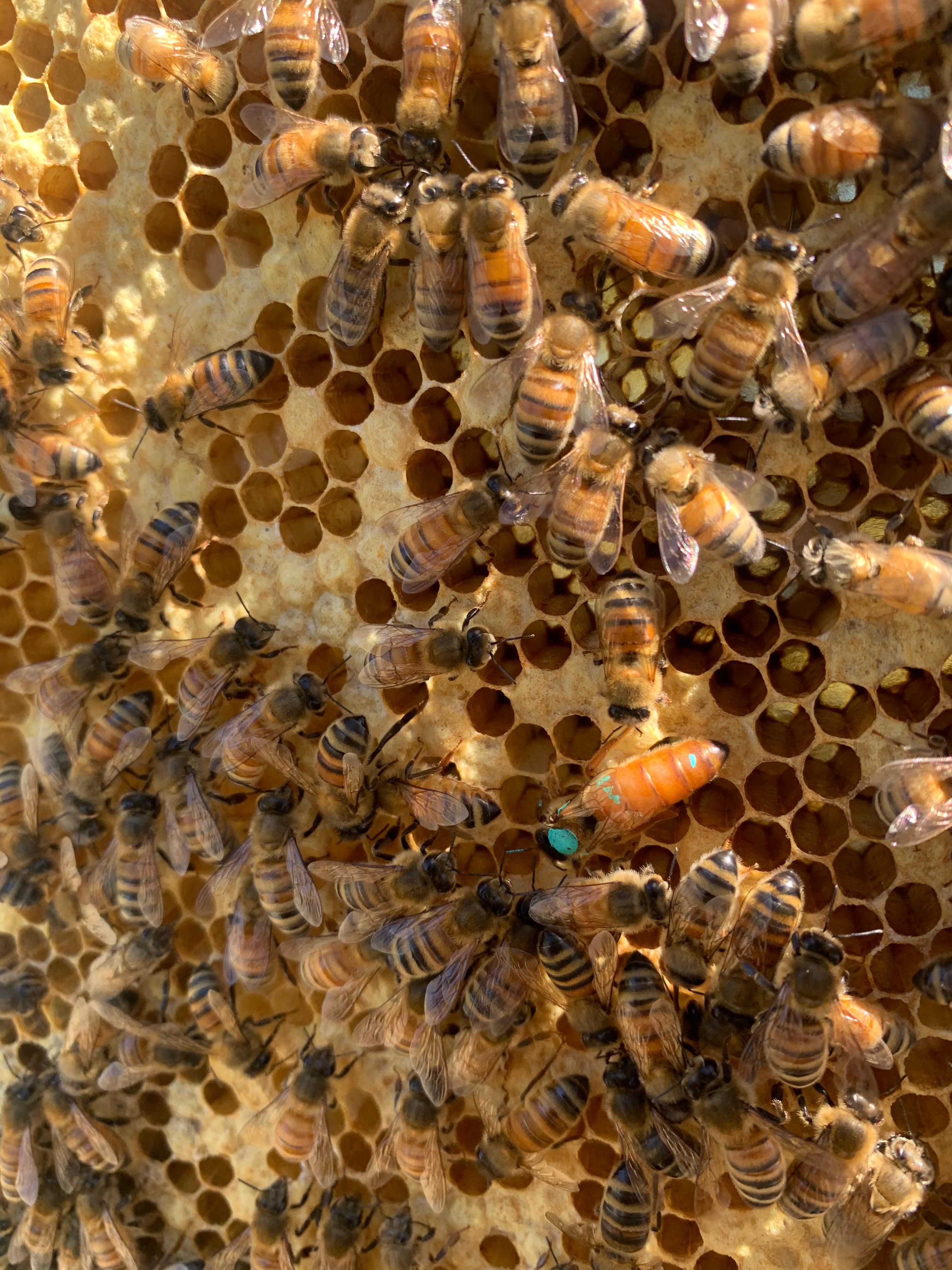
A marked queen is the difference between a five-second confirmation and a ten-minute panic. If you have ever pulled a frame, scanned for the queen, scanned again, started to sweat, and then realised she was on the frame in your other hand the entire time, you already know the case for marking.
It is also the easiest small skill to build in beekeeping. The hard part is committing to do it. The technique is twenty minutes of practice on drones.
The colour convention is international, and it works in Australia
The five-year colour rotation was set by the international beekeeping community decades ago. It is the same in New Zealand, the United States, the UK, Germany, and yes, Australia. The hemisphere does not flip the colours. The year does.
The cycle, by the last digit of the year:
- 1 or 6: white
- 2 or 7: yellow
- 3 or 8: red
- 4 or 9: green
- 0 or 5: blue
So:
- 2024: green
- 2025: blue
- 2026: green (queens that emerged in years ending 4 or 9 wear green; in 2026 itself you are still living with last year's blue queens, but any queen you raise or buy this season is technically yours to mark... see the next paragraph).
Quick clarification, because this trips people up. The colour you paint a queen is the colour for the year she was raised. If you bought a 2025 queen and you are marking her in 2026, she gets blue. If she emerged from a swarm cell on your bench last week, in 2026, she gets green. The colour is a date stamp, not a fashion choice.
Why marking matters
Beyond the obvious "I can find her":
- Age tracking. A red dot tells you the queen is from 2023 (or 2028, but you will not confuse the two). When her colour stops being current, you start thinking about supersedure.
- Supersedure detection. If you opened your hive last month to a green queen and today the queen is unmarked, the colony has requeened. That is information.
- Lineage. Two yellow queens from this year, both raised from your best survivor stock, both marked, both producible to your buyer as 2027 queens. The mark is part of the provenance.
- Speed. A trained eye finds a marked queen in under a second on a frame. An unmarked queen on a busy frame can be a five-minute search. Across an apiary of fifteen hives, that adds up.
The pens that actually work
You want a water-based paint marker, not a solvent-based pen. Solvent fumes can kill a queen.
The brands you will see in Australian beekeeping suppliers:
- Posca PC-5M in white, yellow, red, green and blue. The standard. A five-pen pack costs about $35 to $45 AUD and lasts a decade. Buy the 2.5 mm tip, not the fine.
- Uni Posca PC-3M is the smaller-tipped sibling. Also fine.
- Apimaye and Better Bee sell branded queen marking pens, which are usually rebadged Posca.
What to avoid: fingernail polish, regular paint markers, paint pens from a hardware store. Solvent kills queens. Cheap acrylic paint stays sticky and the worker bees will groom the queen until they remove it, sometimes pulling out her hairs.
Marking, step by step
There are two schools: the cage-and-plunge method, which is how most beekeepers start, and the bare-fingers method, which is how most experienced beekeepers end up.
Method 1: queen marking cage
A queen marking cage is a circular plastic cage with foam plunger and metal mesh top. About $8 AUD.
- Find the queen on her frame. Do not pull her off the frame yet. Have everything ready.
- Press the cage gently down over her, on the comb, with a dozen attendants around her.
- Slowly push the foam plunger through the mesh until she is held lightly against the mesh, head and thorax exposed. Stop the moment she stops moving. Too much pressure crushes her.
- Shake the pen vigorously for 15 seconds. Test it on a piece of paper. The first stroke after a long wait is always too wet.
- Touch the tip to her thorax, briefly. One small dot the size of a match head. Not on her head. Not on her abdomen. Centre of the thorax.
- Wait 30 seconds for the paint to set, holding the cage steady.
- Withdraw the plunger, lift the cage, and let her walk back into the colony.
Method 2: pick her up by the wings
This is faster and, once you trust your hands, less stressful for the queen.
- Find her on a frame.
- With your dominant hand, pinch both her wings together gently between thumb and forefinger. Lift her off the frame.
- Put the frame back. Now you are standing with a queen in your fingers and the hive open behind you.
- With your other hand, transfer her to a grip on the thorax: thumb, forefinger and middle finger making a tripod. She cannot sting you. Even if she tried, queens almost never sting.
- Mark the thorax with a single shaken pen tip.
- Wait 20 seconds. Place her back on a frame in the brood nest, on her feet, watching her walk away.
The first three times you try Method 2, your heart will hammer and your hand will shake. Practice on drones. Drones cannot sting at all and they look enough like a queen for the muscle memory to transfer.
Marking a virgin versus a mated queen
A few extra cautions for virgins:
- Wait until she is laying. A virgin queen released back into a colony after marking is more likely to be balled by the workers. Once she is laying, the colony's acceptance is locked in.
- If you absolutely must mark a virgin (e.g. you are tracking emergence dates on a graft), mark her in the cage, hold her for a full minute for the paint to dry hard, and release her into a queenless mini-nuc rather than back into the rearing colony.
- Never mark a queen on her mating flight day. Queens that have flown out of the hive that morning are wound up. Many drop off the comb when handled.
For mated, laying queens, the procedure is the same as above. The mark lasts the queen's life. Workers will groom at the edges over time but the centre of the thorax stays visible for years.
A small habit that pays for itself
Mark every queen you see this year. By spring 2027, every hive you open will tell you, in one second, who is in charge and how old she is. The first time you spot an unmarked queen in a hive that should have a green one, the diagnostic work has already started, and you will know to thank yourself for the dot.